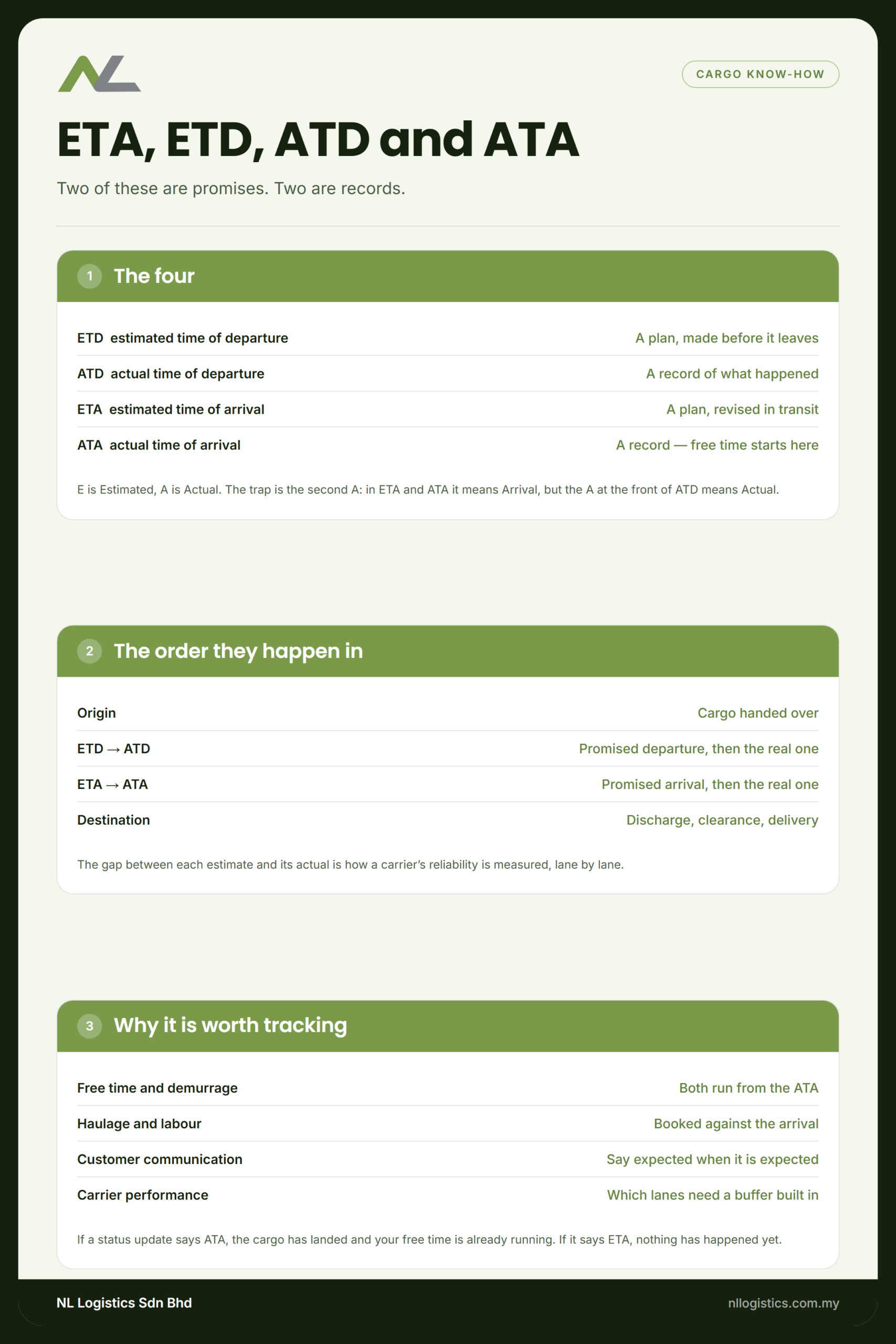
Four abbreviations on every schedule, and the difference between a plan and a fact.
The schedule
Two of these are promises. Two are records.
Every sailing schedule, tracking screen and status email is built from four abbreviations. They look interchangeable and they are not: two of them are estimates made before the event, and two are what actually happened.
Planning against an estimate is normal. Reporting an estimate as though it were a fact is where trouble starts — a customer told the cargo arrived when the schedule only said it was expected is a customer who will find out.
The four
Estimated and actual,
departure and arrival
Read the first letter and you have half the answer: E is expected, A is actual.
ETD
Estimated time of departure
Means
When a vessel, truck, train or shipment is expected to depart from a location.
Made
Before it leaves — it is a plan.
Use it for
Booking cut-offs, and working backwards to when cargo must be delivered in.
Best for
Planning. Never quote it as a fact.
ATD
Actual time of departure
Means
The actual recorded time the vessel, truck, train or shipment departed.
Made
After it leaves — it is a record.
Use it for
Confirming the shipment is genuinely on its way.
Best for
The first hard fact in the journey.
ETA
Estimated time of arrival
Means
When the vessel, truck, train or shipment is expected to arrive at a destination.
Made
Before it lands, and revised as the voyage runs.
Use it for
Free-time planning, haulage booking and telling the consignee when to expect it.
Best for
The figure everything downstream is planned against.
ATA
Actual time of arrival
Means
The actual recorded time the vessel, truck, train or shipment arrived.
Made
On arrival — it is a record.
Use it for
Starting the demurrage clock, and measuring the carrier against its own schedule.
Best for
The moment the free-time countdown begins.
The order they happen in
One leg,
four timestamps
Comparing the estimates against the actuals is how a carrier’s reliability is measured — and how you learn which lane needs a buffer.
Origin to destination
01
Origin
Cargo is ready and handed over.
02
ETD
Estimated departure — the schedule’s promise.
03
ATD
Actual departure — what the record says happened.
04
ETA
Estimated arrival, revised in transit.
05
ATA
Actual arrival — and the free-time clock starts.
06
Destination
Discharge, clearance and delivery follow from here.
Why anyone tracks this
What the four timestamps are actually for
Every one of these is a decision somebody has to make with the information the schedule gives them.
Shipment tracking
Where the cargo is, and whether it is running to plan or drifting from it.
Transport planning
Haulage, cranes and labour booked against the arrival, not against a guess.
Customer communication
Telling a consignee what is expected and what is confirmed, and not confusing the two.
Inventory management
Stock arriving on a known date rather than a hopeful one.
Port and terminal planning
Berth windows, yard space and the queue your box will join.
Delay and performance analysis
The gap between estimated and actual, lane by lane, over time.
Customs coordination
Declarations filed against the real arrival so clearance is not the thing holding the box.
Carrier performance
Which lines keep their schedules on your lanes, and which need a buffer built in.
Also worth keeping
What it looks like on a real routing
An illustration on a Penang lane with a Singapore transhipment. Every leg has both a plan and a record, and the gap between them is the thing worth watching.
Penang — departure
ETD 20 Aug 08:00 · ATD 20 Aug 09:15
An hour and a quarter late off the berth. Not yet a problem.
Singapore — arrival
ETA 21 Aug 14:00 · ATA 21 Aug 16:30
Two and a half hours behind. Still inside the connection window.
Singapore — departure
ETD 23 Aug 22:00 · ATD 24 Aug 01:00
Three hours late on the onward leg — transhipment is where delay accumulates.
Jebel Ali — arrival
ETA 30 Aug 08:00 · ATA 30 Aug 11:20
Just over three hours late after ten days. The schedule held.
Before you book
The easiest way to remember it
Read the letters
E = Estimated (expected, planned) · A = Actual (real, recorded) · T = Time · D = Departure · A = Arrival
The trap is the second A. In ETA and ATA it is Arrival; in ATD the A at the front is Actual. If a status update says ATA, the cargo has landed and your free time is already running. If it says ETA, nothing has happened yet.
ETA, ETD, ATD and ATA — the one-page version
The whole guide on a single sheet, sized for WhatsApp and for A4. Ours to give away.